

Dentist Kiel
Root canal treatment Kiel
Modern Endodontics
- Your dentist for microscopic root canal treatment
Out of love for the tooth
Saving Even Severely Damaged Teeth
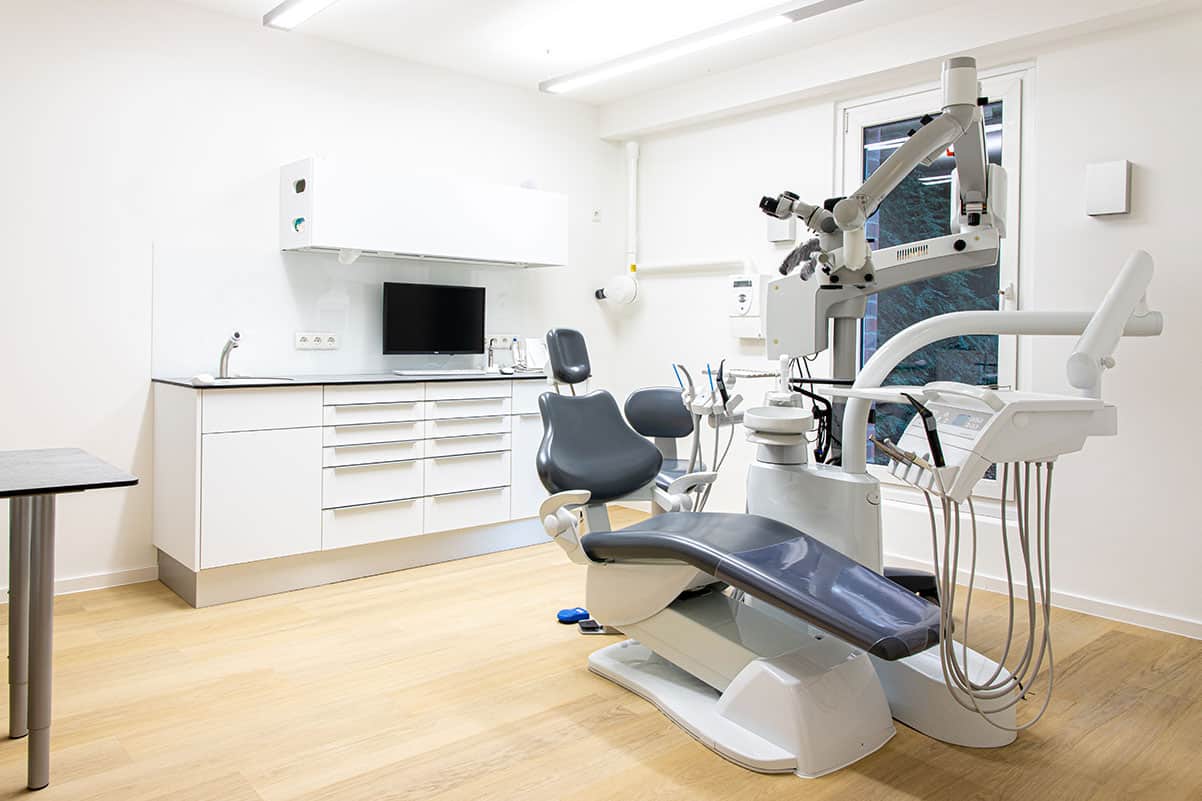
Often, one has to tackle the problem quite literally at the root, or rather, in the root canals. This is precisely one of our specializations at Wurzelwerk in Kiel. A root canal treatment, also called endodontic treatment (endodontics), may be necessary to save an inflamed tooth – this is achieved through the use of the latest technology and years of advanced training in the field of endodontics.
Healthy teeth - for a lifetime
With very rare exceptions, almost all teeth can be root canal treated and thus preserved for a lifetime. Previously treated teeth are no exception; root canal revision is part of our daily practice.
State-of-the-art technology
By employing the most current treatment strategies with care, precision, and our specialization in this field, we will always strive to preserve your tooth. We are convinced that no artificial replacement (e.g., an implant) is better than your own tooth.

Treatment offer
Initial Endodontic Treatment
Root canal treatment
Endodontic Revisions
Treatment of previously root canal treated teeth
Microsurgical procedures
Apicoectomy
Instrument and Pen Removal
Removal of root canal posts and instruments
Apexification
Root canal
Treatment of resorptions
Treatment of internal and external root resorption
Patching perforations
Treatment of Tooth Root Injuries
Apexogenesis
Treatment of teeth with incomplete root formation
Internal Whitening
Cosmetic teeth whitening
Concierge service
Expert advice for dental colleagues
When must a
Root canal treatment performed?
Endodontics
There are many reasons for needing root canal treatment. The inflammation is often caused by bacteria that have entered the pulp, or tooth nerve, through tooth decay. Once in the tooth nerve, the bacteria cause inflammation, known as pulpitis. This inflammation can spread from the tooth root to the tip of the root and ultimately into the bone surrounding the tooth. This is then referred to as apical periodontitis.
Stages of illness
All stages of this disease process can be accompanied by various symptoms, ranging from sharp, prolonged sensitivity to hot and cold, spontaneous pain (especially at night), discomfort when biting down, sensitivity to percussion, to throbbing pain and swelling. However, it is not uncommon for there to be no symptoms at all, and the diagnosis is made incidentally on an X-ray.
CausesStrong
In addition to cavities, bacteria can also enter the tooth's nerve through trauma (e.g., a fall) or through leaky dental restorations (fillings or crowns).
Other possibilities include trauma (e.g., after grinding down teeth), a crack in the tooth (e.g., from grinding or a fall), or also leaky filling and crown margins, which result in a cavity. Furthermore, deep fillings or crowns that are very close to the root canals and thus close to the tooth nerve (pulp) can also necessitate root canal treatment.
Procedure for a
Root canal treatment
Modern root canal treatments have led to a continuously increasing success rate of tooth preservation over the past 20 years, and today almost every tooth can be saved. Through the use of modern technology combined with years of specialization in the field of endodontics, we can often preserve your tooth for a lifetime.
01
Individual
Planning
In the first appointment, we will discuss the treatment plan tailored to you and take any necessary X-rays. Since every tooth is unique, precise treatment planning is crucial for the success of the treatment.
02
Keyhole surgery
The following treatment session begins with the removal of any existing decay on the tooth and a filling to prevent later bacterial entry from the oral cavity into the root canal system. The entire treatment takes place under a rubber dam, a rubber sheet similar to a surgical drape for teeth. Through a precisely drilled hole (trepanation) – even through an existing dental crown – we gain an overview of the existing root canal entrances.
03
Preparation & Disinfection
Next, the infected tissue is removed from the tooth. The root canal systems are measured electronically and additionally checked with X-rays. After intensive and varied rinses for disinfection of the cavities, the tooth is treated with a pain-relieving and disinfecting medication. Finally, the tooth is temporarily sealed.
04
Stability for long-term success
In the final treatment appointment, the final root filling is placed, and the treated tooth is sealed again with a ceramic-composite filling. Only through the placement of this special filling does the tooth regain its stability and bacteria-tightness. Once restored this way, lifelong preservation of the tooth is possible in almost all cases.


Glossary Root Canal Treatment
A type of rubber sheet that isolates the tooth from the rest of the oral cavity. The rubber dam prevents medicinal solutions used to rinse the root canals from entering your mouth. Conversely, your natural oral bacteria will not enter the inside of the tooth.
The root canals have an average diameter of 0.1 mm. A microscope is necessary to recognize the variety of anatomical structures.
Using electronic resistance measurement allows for very precise determination of root canal lengths. You won't feel a thing from the procedure. This is the only way to completely remove bacteria.
Possibilities in Micro-Endodontics
"You can only treat what you see. And you only see it when you know what to look for!“
- Retention of almost all teeth
- Predictable results through detailed planning, including three-dimensional X-rays (DVT)
- through minimally invasive procedures, pain-free treatment possible in almost all cases
Frequently Asked Questions About Root Canal Treatment
Is a root canal treatment painful?
No. Thanks to novel and highly effective medications (anesthetics), such effective anesthetics can be administered that completely pain-free treatment is very often possible.
Even after the treatment, minimal discomfort is only to be expected in exceptional cases.
Why should treatment be performed by an endodontist?
Root canal treatment requires a high degree of experience, as each tooth has a unique anatomy. By specializing in root canal treatments over many years, it is possible to achieve a significantly higher probability of success. Furthermore, teeth that might not be salvageable by general dentists can often be preserved.
What is the advantage of root canal treatment over tooth replacement?
We firmly believe that no dental prosthetic can be as good as nature itself. Root canal treatment is a promising and worthwhile method of treatment and is the only way to avoid a possible tooth extraction. The costs are calculable and in many cases significantly cheaper than tooth replacement (e.g., implants or bridges) in the event of tooth loss.
What is the prognosis for a treated tooth?
The success rate of root canal treatment is stated by the German Society of Endodontology (DGET) to be over 90 percent on average using our treatment methods.
Wie in allen Bereichen der Medizin, kann keine Garantie für einen 100%igen Erfolg gegeben werden. Tritt keine Heilung des Zahnes ein, können weitere Behandlungsschritte wie eine Wurzelspitzenresektion oder die Entfernung des Zahns notwendig werden.

Appointment for a
Schedule a root canal
How can we help you? Call us, send us a message, or easily book your appointment online.